
The Broken Pot
Westerland: The Story behind the Story

It all started with a broken pot.
Late August 1997. On a windy Cotswolds hillside near Turkdean, the Time Team crew, fronted by Tony Robinson, were meticulously uncovering the buried remains of a Roman villa. Field archaeologist Phil Harding was assisted by guest Bill Oddie (he of The Goodies), enlightening him in the way of the trowel.
Bill is working on a potsherd embedded in the wall of the trench when Tony misguidedly tells him to “take it out”, at which he unceremoniously yanks the sherd from the soil, to the consternation of all: “Oh. Wow. That’s a bit rough!” says Tony, “Don’t do anything like this at home!”
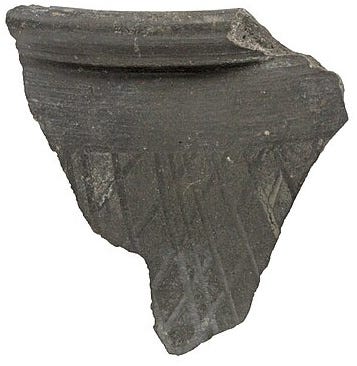
Happily, no damage was done, and later in the episode, in the finds room, Roman expert Lindsay Allason-Jones (author of the rich slice of life novel, Roman Woman), identified it as late 4th, possibly early 5th century. She explained how the white dots—broken sea shells—mixed in the clay were characteristic of South Midlands pottery of this period.
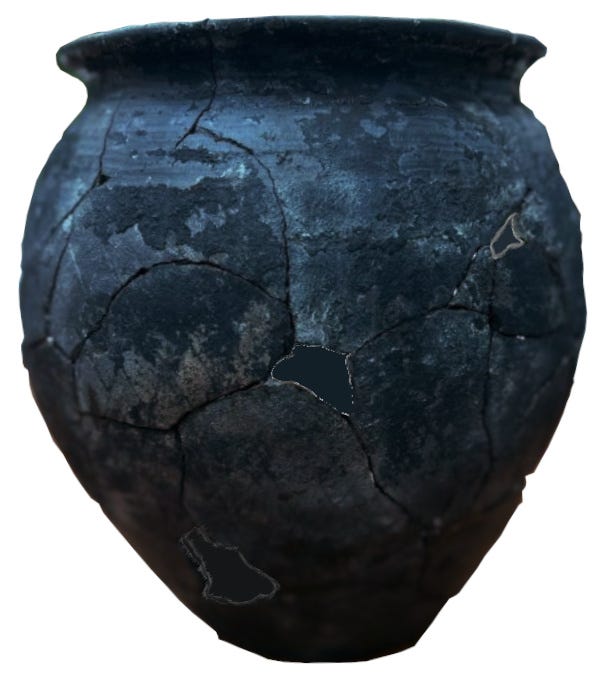
The graphics team created a fine reconstruction of how it would have looked, a black burnished ware pot, approximately 20cm in height, as might have been found in a busy Roman kitchen.
In the episode, they segue to a cameo segment where they are preparing a Roman banquet, dishes from the writings of Apicius, including involuti, cheese wrapped in prosciutto, and isicia, meatballs. The pungent garum fish sauce was a key ingredient. Interesting. Filed for later use.
But for all that, I still found myself stuck on a question that—quite sensibly—nobody was asking: who broke it, and what were the consequences?
What was the human story behind the breakage? This always happens to me with archaeology, whether on TV or visiting a site. For want of a time machine, those questions, of course, remain unanswerable. The everyday events of people’s lives, their hopes and fears. It is my strong belief that those who lived and worked in those places were no different from us, but like the future, for the most part, the past is also unwritten.
So if I wanted to know what happened, I would have to write it. Imagine it for myself. Fortunately, Time Team were on hand with fuel for my imagination.
Turkdean
About nineteen kilometres (twelve miles) north of Cirencester lies the village of Turkdean, nestling in the woods along an escarpment above a diminished watercourse. During the hot summer of 1976, a local farmer, Wilf Musto, had sketched a plan of crop marks that appeared in his field, 1.7 km (about a mile) north-west of the village. An amateur archaeologist, Roger Box, had photographed the area from a helicopter in 1997, confirming that some substantial building had once occupied the site.
The name of the village alone reveals a lot about its history: a Celtic river/deity name, the Saxon word for valley, and Norman bureaucracy. All very suggestive of a cultural mixing that belies the bloody replacement narrative for the adventus Saxonum, the arrival of the Saxons. A theme that surfaces in Westerland.
Turkdean appears in the written records initially in the 8th century as Turcandene, then in the Domesday Book of 1086 as Turchedene or Turghedene. The name derives from the Old English for the coombe or valley (denu) of a river called Turce, possibly a lost Celtic river name, meaning boar (source: “Turkdean,” Wikipedia), as appears in the Welsh Mabinogion: Twrch Trwyth. An equivalently named Cwmtwrch exists today in Wales, north of Swansea on its own Afon Twrch.
The Dig
On the team’s arrival, parchment marks, as Mick Aston called them, were clearly visible on the ground. He went on to explain how stone walls, just under the surface of the turf, deprive the grass of water, causing it to die off in dry conditions, exposing their location. John Gater and his geophysics team (“geophys”) conducted a survey, revealing walls, rooms, and corridors, as clearly as if drawn on an architect’s plan. Mick, with his infectious enthusiasm, identified this as a “Classic Roman Villa” layout. These were the most well-defined results they’d ever obtained with the technology.
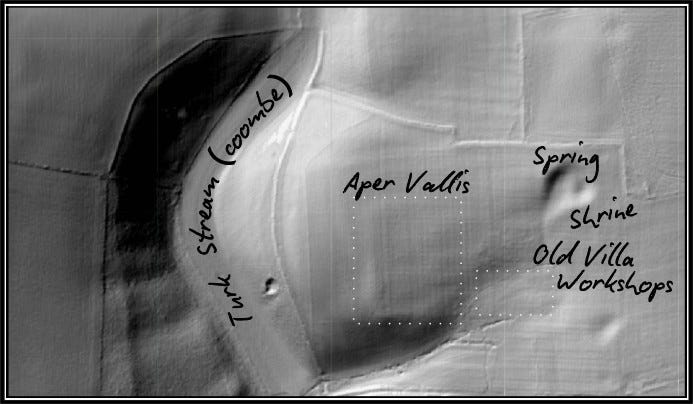
The more recent LiDAR (Light Detection and Ranging) image below clearly reveals the rectangular shape of the villa, the promontory on which it stood, as well as other features in the locality that crop up in Westerland.
In his introduction, Tony Robinson stated that the goal of the dig, over the next three days, was to determine when it was built, how big it was, and who had lived there. It was that last question that engaged me. Although by the end of their endeavours, they could not come up with specific names, the evidence of enlargement and remodelling they discovered was suggestive of locals making good, of the Iron Age/Celtic elite taking advantage of Roman trade connections, rather than Continental Italians arriving and setting up shop. That aspect of Roman Britain doesn’t get as much attention as it should, and, beautiful as the Cotswolds are, the idea of wealthy Romans moving from Tuscany, say, always felt unlikely to me, given the weather—and the quality of local wines.
The investigations showed that the Turkdean site was occupied through the late Roman period and possibly into the first half of the 5th century, as evidenced in nearby Corinium (Cirencester), where civic work, repairs and new building work suggests ‘civilised’ life carried on after the Roman withdrawal, until at least 430.
Using the Time Team discoveries and Neil Holbrook’s archaeological report, I have reimagined the villa as it might have been, populating it with characters inspired by Tony Robinson’s “toga-wearing Brits”. Carenza Lewis helpfully modelled the fashions of the day, further bringing the people to life. The jeans were a tad anachonistic, however.
The map below, drawn by Sarah Waites of Illustrated Page, locates the villa and its surroundings in the real landscape in which my story is set. Visible is the Via Fossa, the Fosse Way, the great Roman highway, running up from the coast at Isca (Exeter) through Aquae Sulis (Bath) and Corinium (Cirencester) and on north to Ratae (Leicester). The fort at Castron (Cold Aston) stood guard on this vital artery.
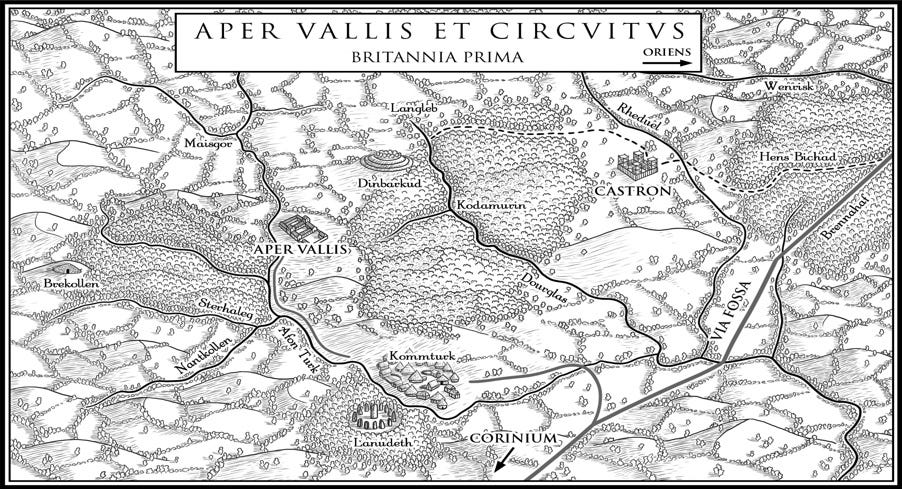
To the west, Brekollen marks Hazelton, site of a Neolithic long barrow, as referenced by Indy in the opening sequence of Raiders of the Lost Ark. My own hero also visits the site in search of buried treasure and we hear the origins of Dr Jones’s golden coffin legend.
At the top of the map, the river Wendrisk appears, the modern Windrush. Its name is likely derived from Brythonic wen reisko: white fen or rushes. The river carries its own poignant immigrant story, giving its name to the Empire Windrush, the ship which also brought new blood and culture to Britain. In this story, it is the Saxons themselves who are the fresh arrivals, the immigrants, their distinctiveness adding to that of the Celtic and Romanised indigenous population. That river flows still.
Behind the Walls
As the dig progressed, the team uncovered evidence of a very substantial Romano-British villa beneath the turf—perhaps one of the biggest in the country—complete with hypocaust central heating, lavish rooms, corridors, and a probable bathhouse. The trenches divulged physical evidence: pottery, hardware, and coins. A fragment of stone, enigmatically inscribed “Fil”, makes an appearance in my story. The origin of the “Trevor” (Utere Felix) brooch is also a plot point in Westerland.
The evocative pen and watercolour sketches of Victor Ambrus brought the discoveries to life for television audiences, helping us picture what the buildings might once have looked like. His work, more than any other single influence, helped me to imagine the villa as a home and working estate. A living presence.
Neil Holbrook’s meticulous site report filled in the details. The phasing, the finds catalogue, the careful interpretation of the evidence. A coin tossed and lost in one scene was refound. A sherd of that black burnished-ware jar broken in the story is listed in the finds catalogue.
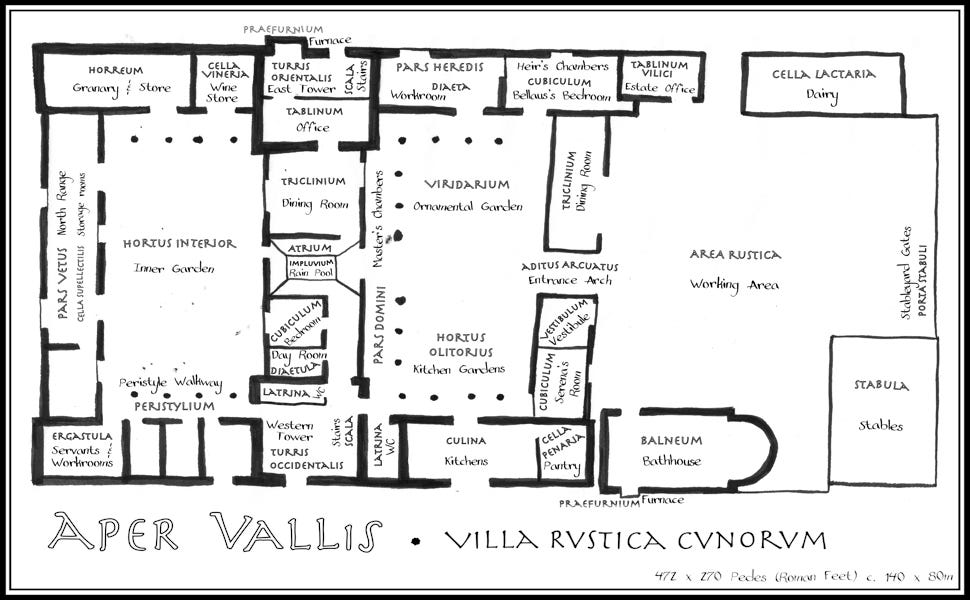
Aper Vallis (“Boar Valley”) is my imagining of how those fallen walls once looked, what they once contained. The people who ate in the triclinium, argued in the tablinum, bathed in the balneum, grew vegetables in the kitchen gardens. In the story, we watch as our hero ‘debugs’ the faulty heating system and later, as the newly-arrived Saxon views the bathhouse with wonder.
Some of the questions asked during the excavation have an answer in Westerland: why was there a bathhouse slap bang in the middle of the villa? Why is the southern range skewed slightly out of true with the rest of the building?
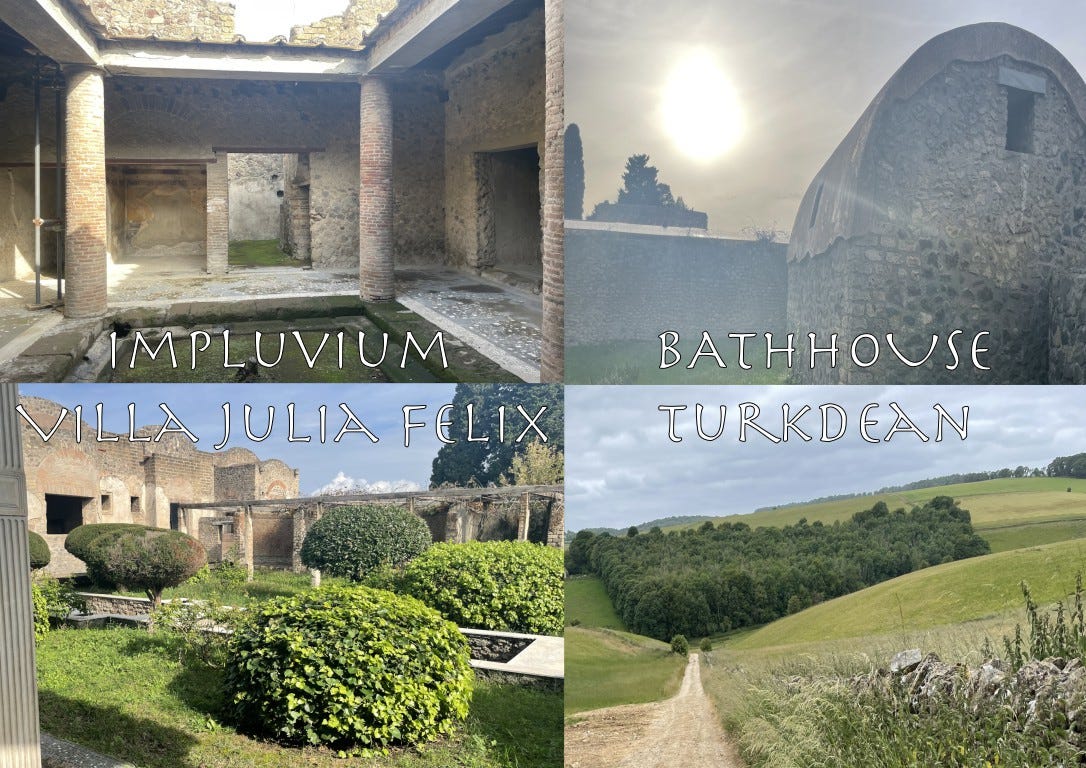
Parts of the novel were written sitting on that hillside, imagining how it must have looked, with bright, whitewashed walls rising around me—a later Saxon charter names the ruins that must have still been visible as Cealcweallas, “Chalk walls” (thanks to Tom Merchant—Allotment Fox on YouTube—for that nugget). My imagination was further helped by visits to Chedworth (Villa Fontis Rosae in the story, named for nearby Pinkwell, also a site of a Neolithic long barrow) that lies seven kilometers (four miles) to the south. Other parts were drafted in the garden of the Villa Julia Felix and other locations in Pompeii. Boy, were they into their fast-food! More of that in book two, though.
Time Team Episodes That Inspired Westerland
As well as striking the initial spark of my story, as it unfolded and grew, other Time Team episodes provided inspiration for scenes and locations. The main ones are listed here, but gems from many digs have crept in, adding colour and, I hope, authenticity.
Turkdean Roman Villa
Series 5, episode 4; Turkdean, Gloucestershire; August 1997
The original inspiration. Provided the villa floor-plan and many of the finds that appear in the story. Its location, on the promontory and with the coombe to the west are the stage where a lot of the drama plays out.
Turkdean II
Series 6, episode 9; Turkdean, Gloucestershire; February 1999
Here, they investigate a potential older villa, further down the slope. In Westerland, this is said to be the original villa built after the Romans arrived and the local Dobunni noble family signed up. Built on the site of an ancestor’s roundhouse palace, it now serves as a guesthouse for visitors with attached stables and workshops (evidence of wooden buildings and industrial workings was found close by).
The spring was also investigated further; the location of the shrine in the story.
There’s A Villa Here Somewhere
Series 17, episode 11; Litlington, Cambridgeshire; November 2010
Here, they excavated the site of the bathhouse amongst trees and shrubs. As Phil and Tony described it to the locals, I could picture how it would have appeared to a Saxon arriving after abandonment. That perspective appears in the story on a couple of occasions: in a deserted Noviomagus Reginorum (Chichester), and at the villa itself.
The Roman Bathhouse
Series 6, episode 7; Beauport Park, Sussex; February 1999
The beehive smelting furnaces and the cameo reconstruction provide the colour for a scene set in Beccs Hoh (modern Bexhill-on-Sea), a working industrial landscape that contrasts sharply with the villa world of the story’s opening.
In The Halls Of A Saxon King
Series 17, episode 4; Drayton, Oxon; May 2010
An unprepossessing field in sight of the—since demolished—cooling towers of Didcot power station, and a location I must have ridden past a hundred times on my way to work, unaware. The site yielded evidence of Grubenhäuser (“Pit Houses”, or Sunken Feature Buildings), Long Houses, and a Saxon Hall, possibly of royal status. Massive postholes suggested an Irminsul—a Saxon totem pole—once stood guard there. All of these features make it into the story.
Time Team Extra — Turkdean
Series 1, episode 4; Cirencester, Gloucestershire; 1998
Robin Bush quotes Monty Python's Life Of Brian: “What have the Romans ever done for us?” His answer is: quite a lot.
In conversation with Guy De La Bédoyère, and drawing on meticulous historical research, they place the dig in its broader setting, invaluable in helping me understand how the villa connected to the civic life of Corinium, just twelve miles down the Fosse Way.
Robin visits the Corinium Museum with Lindsay Allason-Jones, where they move through reconstructed rooms and a kitchen, further helping me picture the villa in its heyday. The bathhouse, hypocaust details and nymphaeum all contribute details to the story.
Backfilling
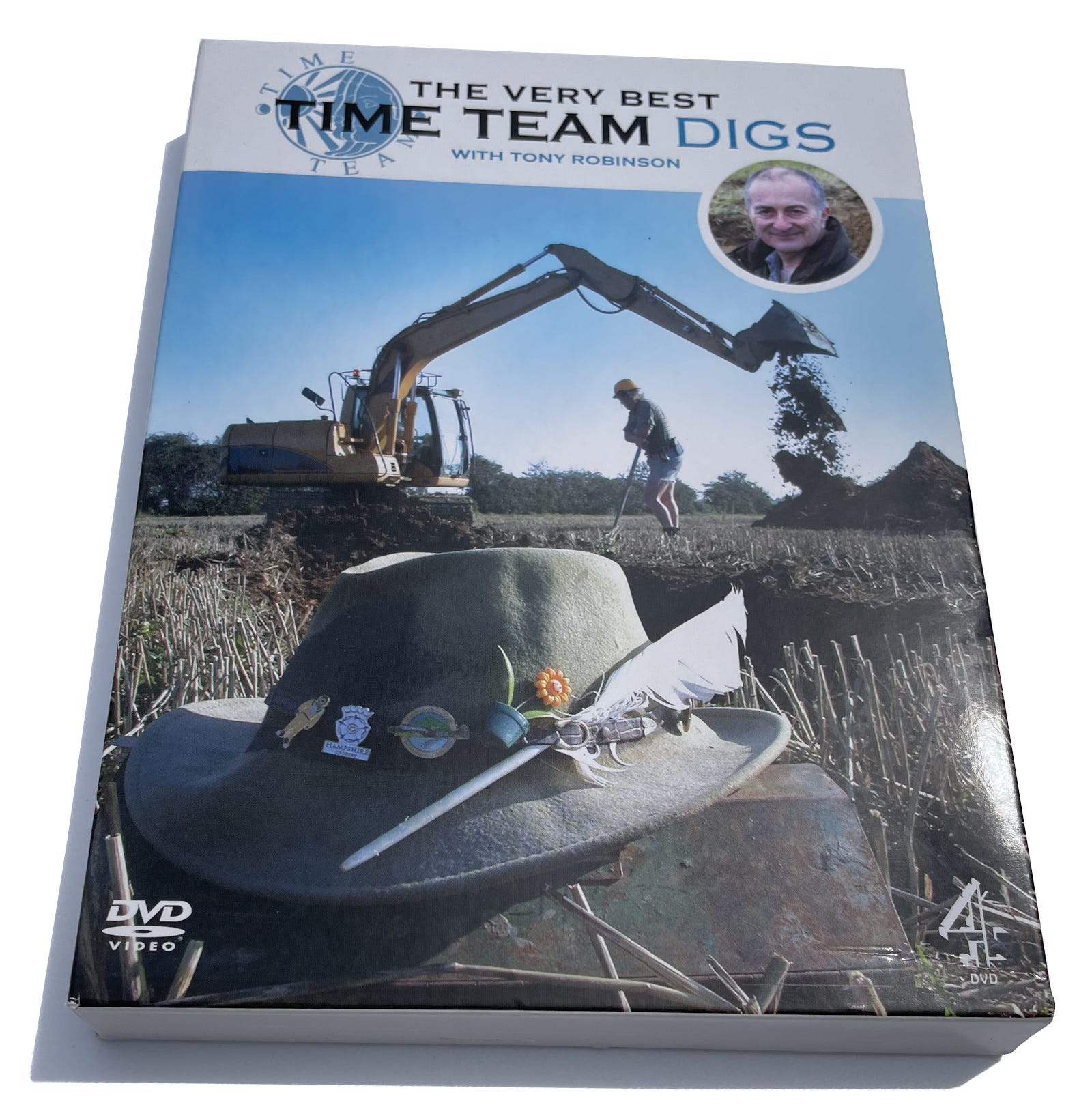
This is the point where, in true Time Team style, we should retire to the nearest hostelry for a well-earned pint or two, and argue about what it all means. In lieu of that, I can only recommend the above DVD for seven hours of viewing that will inform, educate, and most certainly, entertain, as Lord Reith put it. Before that, let's raise a glass in memory of Mick Aston, Victor Ambrus, Robin Bush, and Kerry Ely, and drink to the skills, knowledge and enthusiasm they shared with us all. Prosit!
Oh, and look out for Westerland from all good booksellers, as well as Amazon, on its release in August 2026, to find out who did break the pot, and what consequences befell them.